Friday, January 7, 2011

Photos of our herd Sire

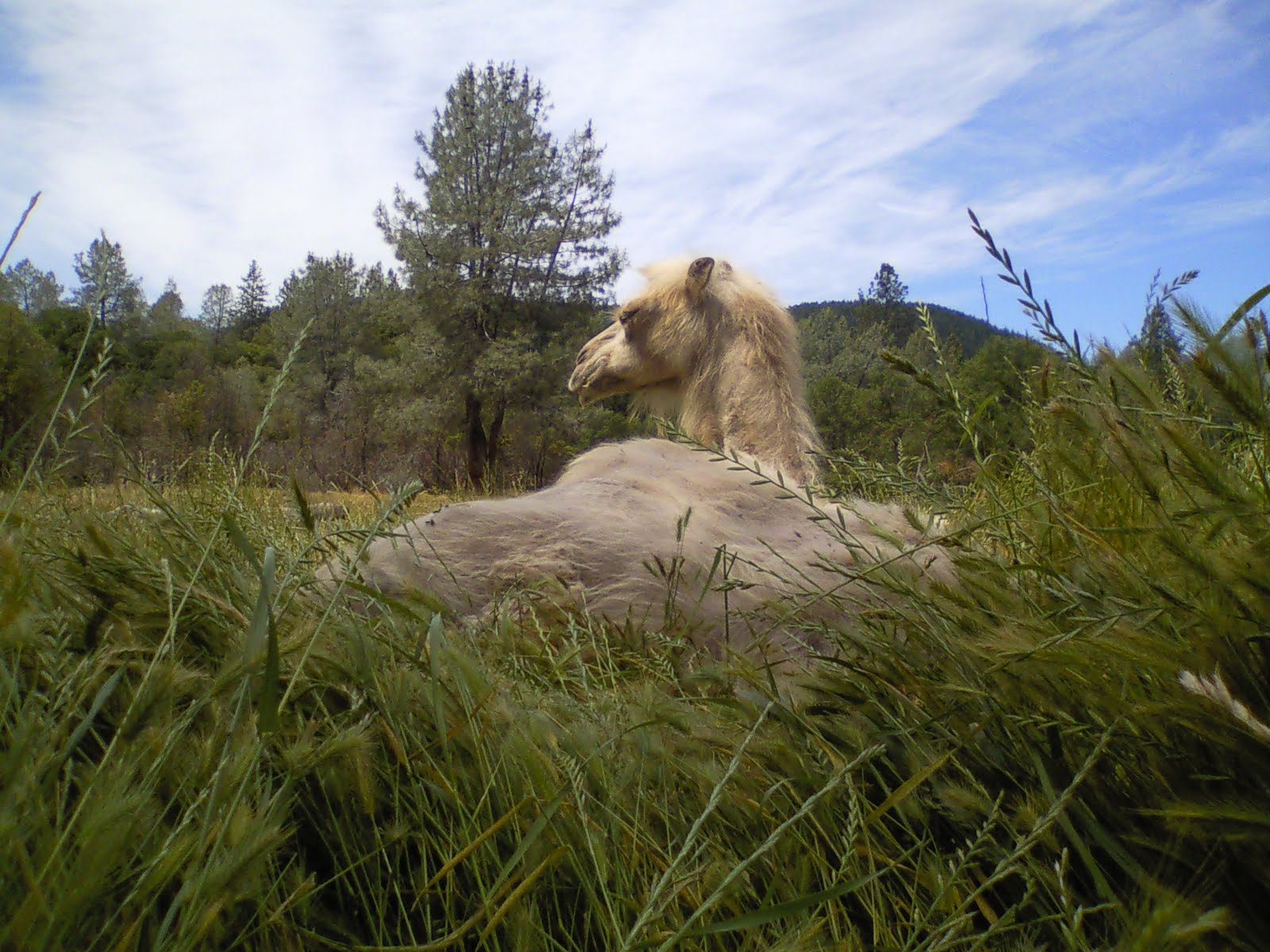
Everest, son of Tom Dooley, is our handsome herd sire. Everest is large, with a great disposition, massive humps and big barrel belly. He is  five years of age. These photos are dated January 2011. Photos of our two yearling bulls for sale will be uploaded soon. Please check back. See previous post for our philosophy on selling our camels...


Our Approach to Selling Camels

Philosophy - always in consideration...

We keep our herd of Bactrian camels in a spacious 40 acre park-like setting. With one bull, eight cows and two fixed males they live a fairly natural herd life, are well fed and cared for and lovingly related to. Each season, in the natural course of things, they breed, and young are produced. Most of these young camels need to be sold for reasons of maintaining herd integrity, affordability of our non-profit project and healthy land usage.

You will receive camels from us as healthy, well-trained individuals, with good manners and a happy respect for people. Likewise, we are looking for the new owners of our camels to be happy and healthy, with good manners and a deep respect for camels and all living things. We will only place our camels into homes, and with people, where they will be loved and well cared for.

It's time to change the way humans tend to buy and sell, and invariably abuse. We can do things differently.

Each year we offer a select number of camels for sale. We like our camels stay with their mothers, and with the herd, until they are about 10 months of age. This way they grow up knowing they are camels, and receive significant input and education from the herd, and us, before they move out to live with you. This time also allows us to better know what their strengths and weaknesses are so we can better match them with their new homes and caretakers.

In the wild, in optimal circumstances, young camels are naturally weaned from their mothers between one and two years of age. At around two they are sent out of the herd by the elders.Our approach embraces more the natural culture of the camel herd, resulting in better adjusted camels.

There have been cultures that sold and owned nothing, realizing that nothing can be owned... not land, nor rivers, nor water... and not animals. In such cultures the "human beings" recognized themselves as caretakers of the fields, protectors of the rivers and forests. And they saw all these as brothers, conscious and equal.

I have sat hours on end among the herd, considered long and hard how to approach the business of selling my friends. Gradually it is becoming clear. If you resonate with our approach and would like to consider acquiring one of our valued herd members we'd be happy to hear from you.


Buying one of our camels

When you get one of our camels you don't just get a beautiful healthy, polite, respectful, camel who was lovingly raised by his or her mother. You don't just get a camel who likes and trusts people.

When you get one of our camels you are also accepting a relationship that requires love, patience, kindness, respect, mutual acceptance and learning. When you get one of our camels you will be entering into a world felt between humans and non-humans that is not about training, controlling and having, but about listening, feeling and giving. You will not just be buying a camel. You will be receiving so much more that it might just change and enhance your outlook on everything.

If you want to join your life with a camel's I invite you to consider another approach from the usual. Whether you acquire one of our camels, or one from somewhere else, I invite you to not just think of him or her as an equal, but to live the Golden Rule in relationship. And something almost magical will happen...

Sales contracts and delivery arrangements are handled in person, case by case.

Facilities requirements we recommend:
1. sufficient room for your camel(s) to be able to wander and to run
2. a sturdy shelter from heavy rain, snow and sun
3. an area of raised, solid, ground that will never get muddy, including inside shelter
4. clean water supply
5. good alkaline grass hay (or alfalfa mix), grain feed, tree cuttings and supplements (we will advise)
6. capability to afford having a large animal, including vet care and insurance if you choose or need to have insurance
7. the time, patience and care to put in to make the camel's life full and interesting
8. preferably a second camel, or more... herd animals do best with company


"Camels see the world from a unique point of view."

As each person sees the world uniquely, so too does each form of life on earth. Camels, likewise, are unique, as is each individual camel. Are you ready to begin discovering what and who a camel is? Are you ready to look beyond owning and having, beyond controlling and riding, just because you can, or want to? Are you ready to reach across the apparent divide between human and non-human, to listen, feel and respect, and to simply "be" with your camel... and yourself?

What you do with you camel is not of as much concern as how you do it and why, with how much humanity, sensitivity and regard. If you want one of our camels this is where our conversation begins. What is important is that your camel will WANT to do things with you. We want your camel to like and respect you that much, to be interested and bonded with you to that degree, and you the same. If you want this too, then it is completely possible, and quite easy to achieve. We will show you how.

Once you know how, the rest is between you and your happy, gentle, giant, camel.

Sincerely,
Stuart Camps

Monday, December 27, 2010

Yearling Bactrian Camels For Sale

We have two young Bactrian Camels for sale.
One is white. The other brown. Both in good health and size. Well disposed and basic trained.
More info and photos to be posted here soon.

Stuart

Friday, August 20, 2010

Camel Herd Visits Herd Member's Grave


Sacred Camel Herd Visits Jelly Baba's Grave
On Friday August 13, Jelly Baba, the large black bull of the Sacred Camel Herd, passed away. Jelly was born March 13, 2004 and left behind him 13 camels. He was six years old. It had been decided to not breed Jelly Baba anymore so we decided to geld him so that he could join the herd and live an enjoyable herd life once again, rather than live horny and apart from the others. The main bull of the herd is the great, white, Everest, one of the top white Bactrian bulls in North America. During Jelly's simple gelding procedure, while under sedation, he quietly passed out of the body.

A ceremony was done shortly after the time of his death and another later in the day, and he was buried like a saint.

When I visited the herd the day following Jelly's passing I found the whole group sitting together right on his grave-site, quiet, calm, peaceful, connected, contemplating. They do like to sit on soft, freshly turned, earth, but there was more too it than just that. I sat down among them. I lay across a couple. Google Mama reached out and touched my hand... Imperceptibly, I gradually felt like I was on Jelly's back... yet with him already gone over and me still here... all the camels staying connected through his passing... feeling deeply, as they always do... and drawing me there, too...

They've continued visiting and sitting together on the grave at random intervals.

Please read the short tribute story about Jelly Baba at the bottom of this post. Also scroll down through the two previous posts to see a photo essay of Jelly Baba reclining under a tall oak.


Inspiration for Camel Temple
Some form of shrine was in the plans soon after Jelly passed away. Seeing the camels sitting over the body of the great Jelly Baba gave vision to a layout that will make the Temple fully usable by them. A spacious elemental shrine will be developed above Jelly's grave that the camels can enter, hang-out and "odalisque" in... a unique Sacred Camel Temple that they, and we, together, can use and serve.

Peaceful Baba and Jingle Baba, when living in the original Zoo compound in the central core of the Sanctuary, often connected bodily with the Sacred Temples of All True Things Park. I've written about this elsewhere.

Set within a grove of old-man oaks, the basic design of the shrine will include an 80' diameter circle of boulders with one or two entrances. Inside this circle will be a bed of sandy gravel that the camels can roll in. At the rear of the circle will be a higher wall of boulders set on a raised area of concrete with a flower pattern inlay. A ceremony will be engaged here daily to potentize the location, invoking and concentrating benign, positive, Spiritual energy there. The camels will be able to come and go, rubbing on the interior rocks and the boulder circle, and reclining on the sandy gravel pad. The Temple will be open above to sky and trees. As much as possible we will use raw, natural, materials, including boulders and rocks from within the Sacred Camel Gardens. A formal Temple Name is in consideration.


In the wild setting, non-humans move throughout their range for food, water, mineral and herbal sources, and other survival needs. They also interact with their own kind and other species for a variety of reasons, not least including the exchanging and transmission of energies that serve their psychic life as well as their potential for Full Awakening. Non-humans are also drawn to visit and interact with certain natural features in the environment, through which their contemplation is served and supported. This shrine for the Sacred Camels will enhance their already evident connection, and naturally lived process, with the Free, Living, Divine.

This Temple will be a gift from human beings to the non-humans, for the sake of these camels and for non-humans everywhere. And for our sakes too.


Building the Camel Temple
Some aspects of the Temple construction will take time to complete, such as the cement pad, floral inlay (and possibly a sculpture) but the first phase can be done relatively quickly. Installation of the boulders and sandy gravel pad will cost about $3000 USD completed.


Please Join Us to Create This Unique Sacred Camel Temple


Choose from among these payment methods:

- send checks to Sacred Camel Temple, 12040 Seigler Springs Road, Middletown, CA 95461

 - online: via Paypal - indicate for Camel Temple Project


The Little Girl and the Camel (in tribute to Jelly Baba)

The little girl enjoyed the large camels, but was nervous and shy. The young mother reassuringly held her daughter's hand.

The large black bull, Jelly Baba, approached them. He looked down at the girl, leaning slightly toward her. She shuffled back a little.

The bull stood tall again, and quiet. He gazed across the field. Then he pressed his face toward the mother and brushed his great, soft, muzzle against her cheek.

He looked down at the little girl again. She leaned away. He leaned away, too, for a while. Then he brought his face down to the mother and daughter's joined hands.

Jelly Baba opened his mouth around their hands, gently holding them, keeping one eye on the little girl. She was starting to relax.

Jelly Baba gently brushed his whiskers across the mother's cheeks again, and held hands with the pair once more.

Again he stood tall and silent, and calm, for the little girl.

After a while his long, woolly, neck drew right down to her. And this time she drew toward him.

They brushed cheeks and he snorted warm breaths in her ear until she smiled and petted his nose.

Then Jelly Baba looked up, turned and wandered across the field to rejoin his herd.


Sincerely,
Stuart

Sunday, April 11, 2010

April Photos - Da Fear-No-More

The Sacred Camel Gardens
Images of Jelly Baba
Son of Jingle Baba
(five years old, 2500 pounds) 

Monday, March 22, 2010

Baby Bactrian Camels, 2010 - 1st pair

It's been too long since my last post. Have probably lost all "my" readers by now...!

Rather than go back and try to catch up I'll just pick up with current events.

Baby Bactrian Camels! Lots off of them! Well, actually, four of them. Two have been born already, and we are expecting two more in the next month or so.

A handsome little white bull was just born from Everest (his very first offspring), and Google Mama (her fifth baby.) No name yet for this little guy - but soon. And already several weeks old is our first calf of 2010, the little grey bull named, "Sage", who was born onto a bed of spring sage, beneath flowering manzanita bushes. Both are strong, robust, babies with a lot of vitality and curiosity. They will be fun to "train"...

Enjoy the pics below....